A sensor is a device that
provides information about the state of an element, which is correlated with a
mechatronics system. It enables the controller to obtain information on the
status of devices used in the mechatronics system. The signals or information
obtained from various sensors are typically conveyed directly to the
controller. In some cases, the signal is processed through a separate converter
to make it compatible with the controller. Different types of sensors are
incorporated into mechatronics systems, including position sensors, velocity
sensors, temperature sensors, and more. The following sensing effects or events
can be recognized by various mechatronics systems:
- Current sensing
- Motion, positioning sensing
- Velocity, Acceleration sensing
- Flow and level sensing
- Temperature sensing
- Optical or light-sensing
- Pressure and strain sensing
- Sound and vibration sensing
- Magnetic Field Sensing

Sensors are primarily
classified into two groups: contact sensors and non-contact sensors. Contact
sensors require physical touch between the measuring device and the sensor,
whereas non-contact sensors do not require any physical connection between the
device and the sensor. Non-contact sensors are also known as proximity sensors.
Sensors can also be categorized based on the type of signal they receive. There
are two types: digital sensors and analog sensors. Digital sensors detect two
different states of a measuring device, presence or absence, and represent the
state or status with a digital signal (1 or 0). Analog sensors, on the other
hand, are used to measure continuous variables such as temperature, pressure,
and acceleration. They output a linear analog voltage or current based on the
device's condition. The signal received from an analog sensor does not directly
interface with the mechatronics system controller. A separate converter unit is
used to convert the signal into a format understandable by the controller. In
some cases, continuous measuring devices like rotary encoders or linear scales
are used for uninterrupted measurement. These devices provide immediate state
information by generating continuous digital pulses as a signal. Occasionally,
a special type of sensor called a Micro-Electro-Mechanical System (MEMS) is
employed in modern mechatronics systems to transmit specific signals for a
particular device. Below is a concise list of sensors commonly used in
different mechatronics systems.
|
Digital contact sensor
|
Digital non-contact sensor
|
Analog sensor
|
Advanced sensor
|
Continuous measuring sensor
|
|
Limit switch
Pressure switch
Float switch
Flow switch
|
Proximity sensor
Magnetic sensor
Infrared sensor
Tilt sensor
Sound sensor
Smoke sensor
Ultrasonic sensor
PIR sensor
|
Temperature sensor
Light sensor
Touch sensor
Humidity sensor
Strain sensor
LVDT
Flex sensor
Hall sensor
Potentiometer
|
MEMS sensor
Barcode sensor
QR code sensor
Electromagnetic
Identification
Transponder
|
Encoder
Linear scale
Resolver
Tacho
Inductosyn
|
Limit switch:
A limit switch is a simple digital contact-type sensor commonly used in various mechatronics systems to send position signals of a moving appliance. Typically, a limit switch provides two types of signal outputs: Normally Closed (NC) and Normally Open (NO). The picture below shows the internal view of a general type of limit switch.

The limit switch usually consists of a mechanical plunger that can move against spring tension. By applying force to the top of the plunger, it is pushed downward and returns to its original position when the pressure is released. A small snap switch is attached to the plunger and activates or deactivates based on the plunger movement. The snap switch used inside the limit switch is a special type that includes a tiny plunger on top of the switch with a movable contact. This contact changes its position between two fixed contact points, exerting slight pressure on the plunger. In the normal state, the movable contact always connects to one fixed contact point, and when the plunger is pressed, it changes position and connects to the opposite fixed contact. The stationary contacts are normally considered as NC, while the opposite connection is the NO contact. The pictures depict the internal view of a snap switch operated within a limit switch.

Different types of snap switches can be found inside a limit switch, depending on the current-carrying capacity and plunger design. Typically, limit switches utilize micro-snap switches with a capacity of 250 V and 5 Amperes, suitable for mechatronics systems. Various limit switches are available, offering different designs such as roller type, pin type, and more.
Inductive proximity sensor:
An inductive proximity sensor is the most commonly used non-contact digital sensor in mechatronics systems. Inductive proximity switches come in different types based on their construction and functionality, such as NPN or PNP type, plug or cord type, and more. However, the basic working principle remains the same for different inductive proximity switches. The block diagram below illustrates an inductive proximity sensor commonly found in CNC machines.

The left-side picture shows an inductive proximity switch constructed with four components: a coil, oscillator, trigger circuit, and output switching circuit. A coil is typically wrapped on the head face of the proximity switch, just beneath the sensing face. The output of the oscillator circuit is fed to the coil, creating an alternating magnetic field in front of the switch, known as the sensing field. This magnetic field extends outside the proximity switch through a non-metallic lining. When a metallic object like iron, copper, aluminum, or steel comes closer to the alternating magnetic field, it induces an eddy current within that object. The eddy current causes a power loss in the oscillator circuit. As the metallic object gets nearer to the proximity switch, the power loss increases, exerting pressure on the output of the oscillator circuit and reducing the amplitude of the oscillator output (see the right-side picture). Once the amplitude drops below a specific threshold level, the oscillation of the oscillator circuit stops due to the loading caused by the eddy current. At this point, the trigger circuit detects the output of the oscillator circuit and turns on the output switching circuit. The sensing distance of a proximity switch indicates its capability to sense metallic objects up to a maximum distance from the sensing face, which typically depends on the diameter of the sensing coil. A smaller diameter inductive proximity switch has a shorter sensing distance, while a larger one has a longer sensing distance. It's important to note that the sensing distance of the same proximity switch may vary with different sensing objects due to their material properties.

A proximity switch usually has three terminals: positive (+), negative (-), and a switching output terminal. By supplying both the positive and negative terminals (typically using a 24 V DC supply) and sensing it externally, a 24 V DC output can be obtained from the switching output terminal. Proximity switches are commonly available in two types: PNP and NPN. For a PNP-type proximity switch, the switching output is obtained with respect to the negative terminal, while for an NPN type, it is considered with respect to the positive terminal (as shown in the earlier pictures). Sometimes, a single proximity switch can provide both Normally Closed (NC) and Normally Open (NO) switching outputs, resulting in four terminals. An LED is typically included to indicate whether the proximity switch is sensing or not.
Capacitive proximity sensor:
A capacitive proximity sensor is another type of non-contact digital sensor used to sense non-metallic objects and, occasionally, liquid levels. Capacitive proximity sensors or switches can be categorized into two types: dielectric and conductive. Inside a capacitive proximity switch, two plates are positioned in front of the sensing surface, and the sensing object acts as a dielectric between these plates. When the sensing object comes within a certain distance in front of the sensing face, the capacitance value reaches a specific level, triggering a built-in trigger circuit inside the switch and generating a switching output. Capacitive proximity switches are generally more expensive than inductive proximity switches, and their applications are limited in mechatronics systems. The picture below shows a capacitive proximity sensor.

Infrared Sensor:
An infrared sensor is a non-contact digital sensor used to detect opaque and non-metallic objects from a long distance. There are three types of infrared sensors: Thru-beam type, Diffuse reflective type, and Retro-reflective type. In mechatronics systems, infrared sensors are commonly used to sense opaque objects from a distance. The picture below shows a typical infrared sensor.

Thru-beam Infrared sensor - This type of sensor consists of two separate units: an emitter and a receiver (see the picture), both placed on opposite sides of the sensing object. The emitter unit transmits an infrared light beam, which falls directly on the receiver unit through a lens. If an opaque object obstructs the infrared light beam falling on the receiver unit, a switching circuit inside it is activated, providing the necessary sensing output. The great advantage of using this sensor is its long sensing range, but a disadvantage is that it requires two separate wirings for the emitter and receiver units.

Diffuse reflective Infrared sensor - Here, the emitter and receiver are assembled in a single unit. An infrared light beam from the emitter falls on an opaque object through a lens, and the reflected light returns to the receiver segment, turning a switching circuit ON or OFF depending on the presence or absence of the light beam. This sensor is more manageable than the Thru-beam type as it uses a single unit instead of two separate units. The sensing distance of this sensor is always shorter than that of a Thru-beam type sensor, and it requires a bright or shiny surface as the sensing object.

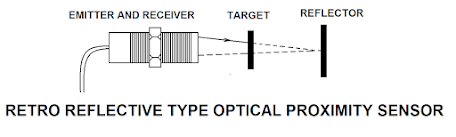
Retro-reflective Infrared sensor - These are the most commonly used sensors in mechatronic systems compared to the other two types. Both the emitter and receiver are assembled in the same unit, similar to the Diffuse-reflective type sensor. A reflector is always used with this sensor, and the infrared light beam transmitted from the emitter is reflected directly from the reflector back to the sensor receiver. When an opaque object appears between the reflector and sensor, the light beam is obstructed, and the sensor turns ON an output switching circuit, indicating the presence of an infrared light source. Operating this sensor is very convenient in any mechatronics system as only one device is required for wiring. The sensing distance is also very high when using a reflector. However, this sensor cannot be used with shiny or reflective surfaces.
Pressure Sensor:
A pressure sensor or pressure switch is a digital contact-type sensing element used to measure the exact pressure level in hydraulic or pneumatic systems. When there is significant pressure inside a pressure line, it activates a small 'Snap switch' and provides a sensing output. The switching output can be either Normally Closed (NC) or Normally Open (NO). A diaphragm or piston is typically fitted inside a pressure switch, influenced by fluid pressure against spring tension, and it activates the snap switch. When the fluid pressure ceases, the snap switch plunger returns to its initial position due to spring tension. The picture below shows a hydraulic pressure switch and its internal configuration. A pressure switch usually has a pressure adjustment knob (see picture) to set the required pressure for switch activation. By adjusting the innerspring tension through a screw, the necessary fluid pressure to activate the snap switch can be increased or decreased. Pressure switches are usually built with different designs and sensing media or elements, such as hydraulic pressure switches and pneumatic pressure switches, among others.

Magnetic Sensor:
A magnetic sensor, commonly known as a magnetic reed switch, is a non-contact digital sensor that activates in the presence of a magnetic field. It consists of two tiny and thin iron plates positioned inside a small glass container, with a small gap between them. When a permanent magnet approaches the glass bulb, one of the inner plates bends and connects to the other, acting as an electric switch. The electrical contact is disconnected when the magnet moves away, returning the plates to their original position. Switching contacts can be of either Normally Open (NO) or Normally Closed (NC) types and are usually integrated into the mechatronic system's magnetic sensor. The picture below shows how a 'Normally Open' type magnetic sensor works.
Level Sensor or Float Switch:
A level sensor or float switch is a digital contact sensor used to measure the liquid level or height. Most float switches work based on the buoyancy principle. A float is typically set inside a float switch, which hovers on the liquid surface and swings upward and downward depending on the liquid level. There is a small magnet inside the float (see the picture), which turns ON or OFF a magnetic reed switch. The magnetic reed switch is positioned inside a tube made of non-magnetic material, allowing the floated magnet to activate the reed switch only when the float reaches a specific position. As a result, the reed switch inside the float switch only activates when the liquid level reaches a predetermined point. The output of the float switch is used in mechatronic systems to specify different liquid levels, such as cutting coolant, hydraulic oil, lubrication oil, etc. The picture below shows the float switch and its interior.

Float switches are usually of two types: vertical and horizontal float switches. A vertical float switch is positioned at the top or bottom of a liquid tank, while a horizontal float switch is fixed along the tank sidewall. The basic working principle for both types of float switches is identical, but there are differences in their construction. Sometimes, analog types of different liquid-level sensors are also used, such as ultrasonic liquid-level sensors, optical liquid-level sensors, hydrostatic liquid-level sensors, etc., to measure the liquid level more precisely. However, the use of these liquid-level sensors with mechatronic systems is limited.
Flow Switch:
A flow switch is a contact-type digital sensor used to detect liquid flow through a pipeline. There are usually two types of flow switches: Piston type and Shuttle type. The picture below explains a piston-type flow switch and its interior.
The picture shows a permanent magnet and a reed switch functioning inside a flow switch. In the piston-type flow switch, the permanent magnet is attached to a piston, which can move against spring tension. When fluid pressure is present in the inlet line, both the piston and magnet move toward the inner side. A reed switch is associated with the body (as shown in the picture) and activates or deactivates with the movement of the permanent magnet. The output signal of a reed switch can be either Normally Closed (NC) or Normally Open (NO), and it is considered an input signal for a mechatronic system. The basic working principle of a Shuttle type flow switch is similar to that of a Piston type flow switch, except a shuttle is used instead of a piston.
Flow Sensor:
A flow sensor is an instrument capable of measuring the amount of liquid (usually water) passing through an orifice. Different types of flow sensing technologies are available, depending on the measurement techniques, such as Mechanical flow meter, Ultrasonic flow meter, Magnetic flow meter, Thermal flow meter, etc. The most common and cost-effective type is a mechanical flow meter, which measures the flow by the rotation of a propeller or paddle-designed turbine wheel. The rotor inside the flow sensor spins proportionally to the liquid flow and generates pulses detected by a Hall effect sensor. By measuring the pulses per second, the controller obtains information about the flow rate through the orifice. The main disadvantage of using this type of flow meter is that it can get clogged when the liquid is dirty or it may not function properly when the water flow is too low. The picture below shows a turbine-type mechanical flow sensor and its interior.
Temperature sensor:
The temperature sensor is commonly used to measure the temperature or temperature changes of an object. It is an analog-type sensor utilized in various applications such as refrigerators, computers, motor control, processing industries, and automobiles. There are three main types of temperature sensors: Thermistor, Thermocouple, and Resistive Temperature Device (RTD), which are frequently found in mechatronics systems. The output signal of the sensor is typically a variable resistance or changing voltage, which is sometimes transmitted through a suitable circuit.
Thermocouple - A thermocouple is made by joining two different metals together, leaving one end open (refer to the picture). The joined end is called the hot junction, while the open end is known as the cold junction. When the hot junction is heated, a small potential difference or voltage is generated between the terminals of the cold junction. By measuring this voltage, a controller can determine the temperature at the hot junction. The amount of voltage depends on the level of heating and the properties of the thermocouple material. To obtain a proper sensing signal, the voltage is passed through an amplifier and converter circuit, which makes it compatible with the controller. Refer to the diagram below for a typical thermocouple system.

Resistive Temperature Device (RTD) - The resistive temperature device (RTD) operates based on the principle that the electrical resistance of a metallic object changes with temperature. It utilizes a length of metallic wire, typically made of platinum, as the sensing element. As the temperature increases, the total resistance of the wire changes, and this changing resistance is considered the output signal of the RTD. Before applying the signal to the controller, it is passed through a suitable circuit. RTDs are commonly used for extremely low and high-temperature measurements. The diagram below illustrates how an RTD works.

Thermistor - The working principle of a thermistor is similar to that of an RTD. However, instead of a metallic wire, a polymer or ceramic material is used in a thermistor, making it more cost-effective compared to an RTD. Most thermistors are of the negative temperature coefficient (NTC) type, meaning their resistance decreases with increasing temperature. Thermistors are suitable for low-temperature measurements. The pictures below show a temperature sensor IC and an NTC thermistor.
Sound sensor:
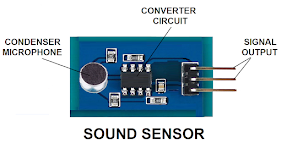
A sound sensor is a digital sensor used to measure the intensity of sound or audio level. When the sound reaches a certain threshold value, the sensor generates a signal voltage. It consists of a small microphone that converts sound into an electrical signal according to its intensity. The output signal from the microphone is sent to an amplifier and then through a circuit to make it suitable for the controller. A potentiometer is used with the sensor board to define the sound intensity at which the sensor should act. Sound sensors are used in various applications, including security systems, monitoring services, and switching applications. Refer to the picture below for a sound sensor.
Light sensor:
A light sensor is an analog-type sensor used to measure the intensity of light. It commonly employs a silicon photodiode, which produces an analog voltage proportional to the light intensity. Another type of light sensor is the Light Dependent Resistor (LDR), which changes its resistance value based on the amount of light falling on it. When no light is present, the resistance of the LDR is high, and as the light intensity increases, the resistance decreases. The output of the LDR is usually passed through a converter circuit to suit the requirements of the control system. These sensors find applications in various fields, including the machining industry, computers, and medical instruments. The pictures below show an LDR and a light sensor.
Tilt sensor:
A tilt sensor is a digital sensor used to detect the orientation or inclination of an object. It consists of two conductive elements placed with a small gap inside a hollow glass cylinder (refer to the picture). A small rolling ball or a mercury blob is present inside the cylinder, which can easily slide. When the sensor is oriented in a specific direction, the rolling ball or mercury blob makes contact between the two conductive elements, acting as a switch and generating a sensing signal output. In an inclined condition, the rolling ball or mercury blob moves away from the conductive elements, disconnecting the switch. Tilt sensors are used in mechatronics systems to secure a specific position. The picture below shows a tilt sensor.
Touch Sensor:
Touch sensors are available in two main types: resistive and capacitive. They are utilized with different operating panels and control boards in mechatronics systems. Capacitive touch sensors are more commonly used compared to resistive ones. A resistive touch sensor is composed of two separate thin conductive layers, usually made of Indium Tin Oxide, separated by a spacer with small spacing between them. A flexible foil film is deposited over them. A small voltage is applied uniformly to the conductive layers. When the surface screen of the sensor is pressed with a finger or stylus, the upper conductive layer touches the lower one, causing a voltage drop between them, which serves as the sensor's output signal. When the pressure is released, the upper layer returns to its initial position. Refer to the picture below for the functioning of a resistive touch sensor.

In a capacitive touch sensor, a thin insulating cover is placed on a conductive coating material, creating a sensing plate. The conductive coating plate acts as an electrode of a capacitor, and the other electrode assumes to be the environment or human finger. By applying a small voltage to the conductive plate, a parasitic capacitor 'Co' is formed between the conductive plate, insulating cover, and the surrounding environment (see the picture). When a finger touches the top surface of the conductive plate, a new capacitance 'Cr' is created by the conductive plate, insulating cover, and a human finger. The resulting difference in capacitance can be recognized as the output of the touch sensor. The following image illustrates the basic working principle of a capacitive touch sensor.
Humidity sensor:
Humidity sensors are analog sensors used to measure the presence of water vapor or moisture in the air or gas. They play a vital role in selecting electrostatic components or operating high-voltage devices. Among different humidity sensors, capacitive humidity sensors are commonly used. These sensors utilize a hygroscopic dielectric material placed between two electrodes. The dielectric material is often made of plastic or polymer, with a dielectric constant ranging from 2 to 15. The dielectric constant of water vapor is higher than that of plastic or polymer at a standard temperature. When a humidity sensor is exposed to the atmosphere, the sensor's dielectric material absorbs water vapor, leading to an increase in capacitance. This change in capacitance is directly related to the moisture present in the air. By measuring the capacitance value of the sensor, the humidity or moisture level can be determined. A converter circuit is typically used with these sensors to interface with the controller. The picture below shows a humidity sensor and its sensing element.

Pressure or strain sensor:
When a force is applied to a stationary object, it leads to two factors: stress and strain. Stress refers to the internal resistance of the object, while strain represents the deformation. A strain sensor or strain gauge is used to measure the deformation of an object based on the applied force. A strain gauge contains a resistor whose resistance value changes with the applied force. By measuring the resistance value, the applied pressure can be determined. Strain gauges are utilized in mechatronics systems to measure force, pressure, tension, and weight on a device. Different shapes and designs of strain gauges are used based on the system's requirements. The picture below shows a strain gauge and its working principle.

In a strain gauge, the total resistance of a metallic wire depends on its length and cross-section. The wire is typically arranged in a zigzag configuration on a springy board inside the strain gauge (refer to the picture). When pressure is applied to the board, the effective length and cross-section of the wire change, resulting in a change in resistance. By measuring the changed resistance value, the applied impact on the strain gauge can be determined. Since the resistance value obtained from a strain gauge is usually very small, a Wheatstone Bridge and an amplifier circuit are used to amplify the signal for the controller, making it measurable.
Linear Variable Differential Transformer or LVDT:
The Linear Variable Differential Transformer, or LVDT, is an analog sensor used to measure small amounts of linear displacement, even up to a micron level, particularly for small objects. It operates on the principle of mutual induction, generating the necessary electrical signal based on the measurement. Inside an LVDT, a core and three coils function as a transformer. The transformer comprises one primary and two secondary coils, with the primary coil typically positioned in the middle of the secondary coils (see picture below). The core, made of magnetic material, smoothly glides inside the cylindrically wrapped coils. A slender rod, usually made of non-magnetic material, is connected to the core and the moving device. The image below displays an LVDT and its structural details.

The resultant flux passes through the core, inducing a voltage in the secondary windings. This induced voltage changes in the secondary coils, displacing the core in either direction. By measuring the induced voltage in the secondary coils, the displacement of the equipment attached to the core can be measured. Additionally, the phase of the induced voltage can be used to determine the direction of the movement. LVDTs find application in various mechatronic systems that require highly accurate or precise linear measurements.
Hall Sensor:
A Hall sensor is an analog sensing device used to measure the strength of a magnetic field. It operates based on the Hall effect principle. When a magnetic field is brought close to a current-carrying conductor, oriented perpendicular to the electric field, a potential difference is generated within that conductor (see picture). The output voltage or potential difference from the sensor indicates the presence of a magnetic field. The output of the Hall sensor is typically passed through a suitable converter circuit to obtain the required signal for a controller. This sensor can only detect either side of a magnetic pole. The left picture below illustrates the Hall effect principle, while the right picture shows a Hall sensor module.
Flex Sensor:
The flex sensor is also an analog-type sensing device used to measure the curvature of an object, indicating its flexibility. It is usually thin and flexible, and its resistance value depends on the curvature of its surface. In a straight position, the sensor has a fixed resistance, which changes based on the curvature. Since mechatronic controllers can only interpret voltage variations as feedback, a suitable voltage driver circuit is used in conjunction with the sensor to obtain the desired signal voltage output. Occasionally, this type of sensor is employed to detect finger movements in robotic arms. The image below depicts a simple flex sensor.
Potentiometer:
At times, a potentiometer is also employed as an analog sensor to determine the position of a moving object or as a position sensor. Potentiometers can be of linear or rotary types, with the type selected depending on the movement being measured. A shaft rotation or slider movement alters the resistance of the potentiometer, allowing for the measurement of the positional changes of a moving device by estimating the corresponding resistance value. Since mechatronic controllers typically measure voltage changes as feedback, a voltage driver circuit is commonly used with a potentiometer to obtain the necessary voltage output. The images below depict a linear potentiometer and a rotary potentiometer.
Smoke Sensor:
A smoke sensor is a digital type sensor commonly found in places like hospitals, shopping malls, and mechatronic systems. It detects the presence of smoke and gas, serving as an indication of a potential fire source. Smoke sensors commonly work in two ways: optical smoke sensing and ionization smoke sensing. Optical smoke sensing relies on the principle of light scatter, while ionization smoke sensors utilize an ionization system to detect the presence of molecules in the air, generating a signal that is acceptable for a controller. The use of these sensors is primarily limited to mechatronic systems. The image below illustrates a smoke sensor.
Ultrasonic Sensor:
The working principle of an ultrasonic sensor is similar to that of the sonar system used in ships. It is a non-contact type digital sensor. In an ultrasonic sensor, a sending and receiving transducer are housed within the same unit (see picture). Ultrasonic sound is transmitted from the sending transducer and returns to the receiving transducer, allowing for the determination of the position of an object by analyzing the reflected signal. Ultrasonic sensors can detect materials such as metal, wood, concrete, rubber, and glass. However, materials like clothes, cotton, and wool are not detected as they absorb ultrasonic waves. These sensors are utilized in various mechatronic systems, including object counting, liquid-level sensing, automatic doors, and robotic systems. The image below displays a complete ultrasonic sensor module.
Motion Sensor:
A motion sensor is a non-contact digital sensor commonly employed in security systems and mechatronic systems. There are three fundamental types of motion sensors: Passive Infrared Sensor (PIR), Microwave Sensor, and Dual-Tech Hybrid Sensor. Among these, PIR sensors are primarily used in security systems. A PIR sensor typically consists of a pyroelectric sensor as the sensing element, covered by a Fresnel lens. The pyroelectric sensor contains a small layer of lithium tantalite sandwiched between two conductors, created through a doping process. It detects the infrared radiation emitted by the human body and generates a small signal. These sensors are accompanied by an amplifier circuit to obtain the required feedback for the controller. A Fresnel lens, a typical design lens cover, is used to protect the pyroelectric sensing element, allowing the accumulation and focusing of the infrared radiation arriving at the sensor. The sensing range of these sensors varies from 8 to 10 meters. When a human or other animal enters the sensing area, the emitted infrared radiation activates the PIR sensor, generating an appropriate signal for the controller. This signal can be used to trigger an alarm system or initiate video recording. The image below shows a passive infrared sensor.

Micro-Electro-Mechanical System or MEMS:
A Micro-Electro-Mechanical System, or MEMS, is an electro-mechanical device typically integrated onto a single silicon substrate. It incorporates micro-sensors, micro-actuators, and other electronic circuits. Some MEMS devices utilize tiny movable contacts. The components in MEMS devices are usually miniature and assembled in a compact structure within a single casing. MEMS devices can be made with ceramic, plastic, or metallic packaging. Different types of MEMS sensors are used in mechatronic systems, automobiles, and mobile phones. The most commonly used MEMS sensors include accelerometers, gyroscopes, and magnetic field sensors. The image below displays a MEMS board and its components. MEMS devices typically generate multiple electrical signals. For instance, a MEMS accelerometer can measure static or dynamic forces resulting from acceleration. A gyroscope can measure changes in angular positions, and a magnetic field sensor can precisely measure incoming magnetic fields. The image below shows three sensors: an accelerometer, gyroscope, and magnetic field sensor integrated within a standard architecture.

Advanced sensing technologies:
We
currently utilize various advanced sensing technologies in conjunction with
different mechatronics systems. These technologies include Bar-code and QR code
Identification, Electromagnetic identification, and Transponders. In a Barcode
identification system, a red light scans a specific pattern of black and white
colors, providing product information that is then sent to a controller or
computer via a sensor. QR code identification involves scanning a QR code image
and collecting the necessary information from a specific website by uploading
the image through an app. The Electromagnetic identification system is similar
to Barcode identification, but instead of using black and white color,
information is stored on a magnetic strip. This system offers the advantage of
being able to retrieve information even if it is submerged in oil or grease.
Transponders work with radio frequency and are used to activate the transponder
itself. For instance, in an advanced automobile engine, when the key is turned
to start the engine, a radio frequency is sent from the car's computer to a
transponder embedded within the key. The car engine will not start until the
response signal is received from the key transponder. Apart from these advanced
sensing technologies, there are other specialized sensing devices used in
mechatronics systems. The following pictures showcase some of these advanced
sensing systems.